Connecting SMOC with MCP to Claude or Any other AI based client
Simple guide showing how to connect SMOC to AI clients and development tools using MCP (Model Context Protocol). Once connected, tools like Claude Desktop, Claude Code, Cursor, or VS Code can read your SMOC data directly — contacts, companies, company assets, flowcharts, flow analytics, LinkedIn inbox threads, and message-flow conversations — scoped to your company. HTTP callers should use the REST v2 API reference.
Get your API key
The SMOC MCP integration authenticates with a private API key. Generate one in the SMOC console:
- Go to Settings → Integrations → MCP.
- Optionally give the key a name and an expiry (7, 30, or 90 days). Leave expiry on No expiry if you do not want it to expire.
- Generate the key and copy it immediately — it's shown only once, so store it somewhere secure.
Your key is tied to your company. Every request made with it is automatically scoped to your data — you'll only ever see contacts, companies, analytics, inbox threads, and conversations that belong to you. Generating a new key does not revoke existing keys. Issued keys are listed on the same page — revoke unused keys there.
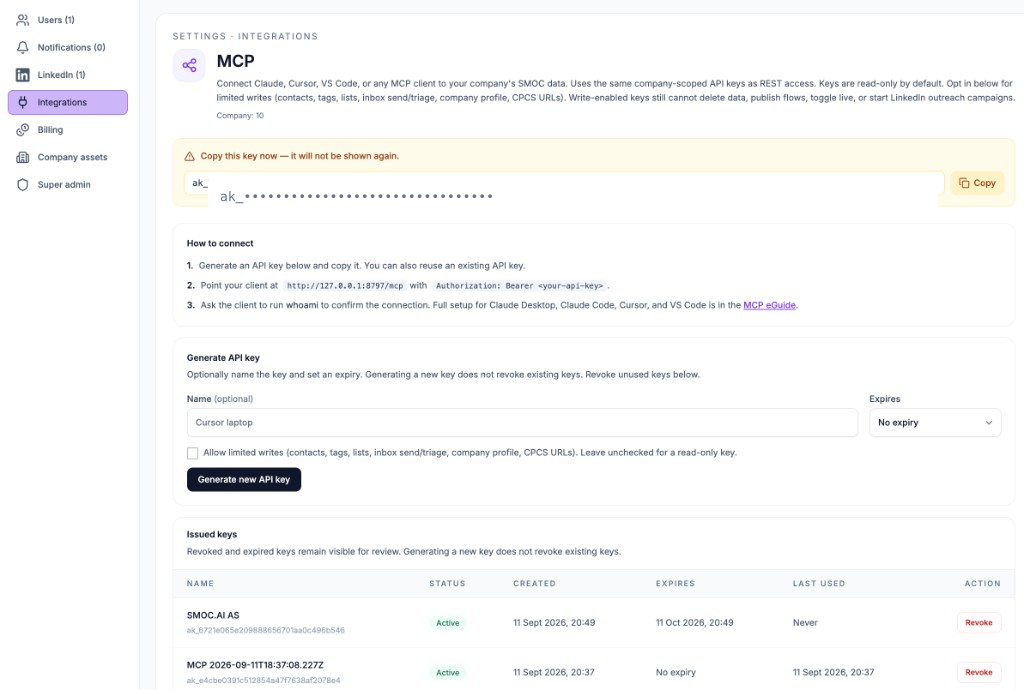
The API and Zapier pages use the same name, expiry, copy-once banner, and issued-keys list.
What you can access
After connecting, the following tools become available (exact availability depends on your account's permissions and the server's configured bindings). Keys are read-only by default. Check Allow limited writes when minting a key to enable the writes listed below.
Discovery
whoami— current role, company scope, and permissionsmcp_capabilities— visible tools, skills, and anything currently unavailableskills_search— find a recipe from a short task phraseskills_get— exact inputs and an example for one skill
Companies & assets
companies_get— company profile (title, key, URL, languages, settings)company_assets_get— products, positioning, website links, and filescompany_asset_extraction_results_list— extraction result summariescompany_asset_extraction_results_get— one extraction result, optionally with extracted datacompany_asset_extraction_templates_list— templates, tags, and freshness
Super-user keys can also call companies_list to browse every company before selecting a companyId.
Contacts
contacts_search— search with filters, sort, and paginationcontacts_get— one sanitized contact by idcontacts_get_stats— counts and engagement summarycontacts_get_filter_options— valid filter values (location, flow, device, and similar)contact_tags_list— contact tagsprospect_lists_list/prospect_lists_get— prospect lists
Inbox & conversations
inbox_threads_list— LinkedIn (and other) inbox threads, with unread / unanswered / sender / flow filtersinbox_threads_get— one thread; setincludeMessages: trueto include recent messagesinbox_messages_list— message history for a thread, including merged peer threadsconversations_list— message-flow runs (enrollment, status, current node)conversations_get— one conversation run, including milestones
Inbox tools require the inbox:read permission. They can read message bodies. Write-enabled keys may also archive, mark unread/handled, and send a text-only reply with inbox_threads_send (requires threadId, body, and idempotencyKey). They cannot attach files, edit flow graphs, publish flows, or start LinkedIn outreach campaigns. Super-user keys can save Mongo flow and theme drafts (flowcharts_save, flowcharts_create, themes_save, and related calls), including web/message and chat/card types. Those writes do not publish.
Flowcharts
flowcharts_list— static flowcharts for the companyflowcharts_get— one flowchart summary or full graphflowchart_recommendations_list— recommendation documents for a flowchartflowcharts_versions_list,themes_get,studio_generation_categories_list, targeting portfolios, and generation/translation job reads- Super-user draft writes:
flowcharts_save,flowcharts_restore_version,flowcharts_create(flowTypeweb or message,webFormatchat or card),flowcharts_duplicate,themes_save. These write Mongo drafts and do not publish. - CPCS reads:
cpcs_overview, URLs, crawls, extractions, templates, schedule
Flow analytics
analytics_flow_list_flows— flows ranked by trafficanalytics_flow_kpis— totals, conversion, previous-period deltasanalytics_flow_timeseries— daily or monthly trendsanalytics_flow_dimension_metrics— breakdowns by device, country, language, UTM, or day of weekanalytics_flow_filter_values— valid analytics filter values
Customer keys are always limited to your own company. Super-user keys can pass companyId on scoped tools.
Connect in Claude (web and desktop)
Add SMOC as a custom connector. This works on claude.ai and in the Claude desktop app. You can sign in with your SMOC account, or connect with an API key.
Quick start
MCP endpoint: https://api.smoc.ai/mcp
Sign in
- In Claude, open Customize, then + Add.
- Name the connector SMOC and paste the MCP endpoint. Leave sign-in on. Do not choose No sign-in and do not add a request header.
- When Claude asks you to connect, sign in with a company admin account.
- In a chat, open +, choose Connectors, and turn SMOC on. Ask Claude to run
whoami.
Sign-in is only for company admins. It can read that company's data. Members and other roles are denied. It does not enable the limited writes you opt into when minting an API key. If you admin more than one company, use an API key for the company you want.
On Team and Enterprise, an Owner adds the connector under Organization settings → Connectors → + Add → Custom. Members then turn it on from Customize.
Or add an API key
- Generate an API key under Settings → Integrations → MCP and copy it.
- In Claude, open Customize, then + Add.
- Name the connector SMOC and paste the MCP endpoint.
- Choose No sign-in. Under Request headers, select
authorizationand set the value toBearer YOUR_SMOC_API_KEY— include the word Bearer and the space. Mark the header Required, then add the connector.
Use a key when you want one company, an expiry, or limited writes. Request headers are rolling out. If + Add has no Request headers section, use Claude Code or the desktop config file below.
Connect in ChatGPT
ChatGPT adds SMOC as an app. The create screen uses sign-in and has no field for an API key. Sign in with a company admin account.
Quick start
MCP endpoint: https://api.smoc.ai/mcp
- Open Settings → Apps → Advanced settings and turn on Developer mode. On Business, Enterprise, or Edu, a workspace admin turns that on under Workspace settings → Permissions & Roles first.
- Open Apps → Create. Name the app SMOC and paste the MCP endpoint.
- Choose OAuth, then Scan tools. Sign in with a company admin account when ChatGPT asks, then click Create.
- In a chat, open the tools menu and turn SMOC on. Ask ChatGPT to run
whoami.
Sign-in is only for company admins. It can read that company's data. Members are denied. API keys are for Claude, Cursor, and VS Code. ChatGPT needs a Plus, Pro, Business, Enterprise, or Edu plan for custom apps.
Connect to Claude Desktop with a config file
Use this when the connector dialog cannot take an API key. SMOC then connects through a small local bridge (mcp-remote).
- Open Claude Desktop → Settings → Developer → Edit Config. This opens
claude_desktop_config.json. - Add SMOC under
mcpServers:
{
  "mcpServers": {
    "smoc": {
      "command": "npx",
      "args": [
        "-y",
        "mcp-remote",
        "https://api.smoc.ai/mcp",
        "--header",
        "Authorization: Bearer YOUR_SMOC_API_KEY"
      ]
    }
  }
}
- Replace
YOUR_SMOC_API_KEYwith the key you generated. - Save the file and restart Claude Desktop.
SMOC will now appear in your tools list. Requires Node.js installed (for npx).
Connect to Claude Code
Claude Code can talk to the SMOC endpoint directly with an authentication header — no bridge needed.
claude mcp add --transport http smoc https://api.smoc.ai/mcp \
  --header "Authorization: Bearer YOUR_SMOC_API_KEY"
On Claude Code 2.1.1 and newer you can also add it as JSON:
claude mcp add-json smoc \
  '{"type":"http","url":"https://api.smoc.ai/mcp","headers":{"Authorization":"Bearer YOUR_SMOC_API_KEY"}}'
Verify it connected by running /mcp inside a Claude Code session — SMOC should show as connected with its tools listed.
Connect to other clients (Cursor, VS Code, Windsurf, etc.)
Most MCP-capable editors use a JSON config file (often mcp.json). Add an HTTP server entry pointing at the SMOC endpoint with your key in the Authorization header:
{
  "mcpServers": {
    "smoc": {
      "type": "http",
      "url": "https://api.smoc.ai/mcp",
      "headers": {
        "Authorization": "Bearer YOUR_SMOC_API_KEY"
      }
    }
  }
}
Refer to your editor's MCP documentation for the exact file location. After saving, restart or reload the editor.
Verify the connection
- Health check: the endpoint exposes
GET https://api.smoc.ai/mcp/health. - Identity check: ask the AI to run the
whoamitool — it returns who you're connected as and your company scope. This is the quickest way to confirm the key works.
Discovering tools
The AI doesn't need to know SMOC's tool names in advance. The intended flow is:
mcp_capabilities— lists the available tools, your role, and your scope.skills_search— describe the task in a short phrase to find the right tool.skills_get— returns the exact inputs and an example for the chosen tool.- Call the tool.
In practice you can just ask in plain language (e.g. "search my SMOC contacts in Oslo" or "show unanswered LinkedIn inbox threads") and the client picks the right tool.
Security notes
- Your API key is shown once at creation — store it in a password manager or environment variable.
- Never commit the key to a Git repository or paste it into a shared/public config.
- Generating a new key does not revoke existing keys. Revoke unused keys from the issued-keys list on Settings → Integrations → MCP.
- Customer keys are read-only by default and confined to your company's data. Write-enabled keys may update contacts, tags, lists, company profile, add CPCS URLs, triage inbox, and send text inbox replies. They cannot delete data, publish flows, toggle live, or start LinkedIn outreach campaigns.
- Inbox and conversation tools need
inbox:readon the key. New keys from Settings → Integrations → MCP include it; older keys need a rotation.
Troubleshooting
- Tools are missing from the list: the AI can run
mcp_capabilitiesand checkunavailableTools— it names the exact missing permission your key needs. - Authentication fails: confirm the key is correct, hasn't been revoked, and that the header is exactly
Authorization: Bearer <key>. - Claude's + Add dialog has no Request headers: use the Claude Code command or the
mcp-remoteconfig above. Make sure Node.js is installed, the config JSON is valid, and you fully restarted Claude Desktop after editing the config.
See also
- REST v2 API reference — every
POST /api/v2/{toolName}call - Connecting SMOC with the REST API
- Public Contacts API
- MCP for Claude, Cursor, and VS Code
Related Guides
Continue learning with these related guides

Stay close to the shift in AI sales
Get product updates and perspective on proactive AI agents, multichannel orchestration, and conversion—without the noise.
 Weekly signal on proactive AI sales